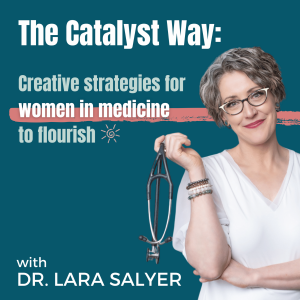
The Catalyst Way™: Creative Strategies for Women in Medicine to Flourish
Welcome to The Catalyst Way—the podcast for women clinicians who want to get organized, reignite creativity, and flourish in medicine. Hosted by Dr. Lara Salyer, DO, IFMCP, a physician, author, mentor, and Flow Research Collective-trained coach, this show is your weekly dose of practical strategies to help you flourish inside and outside the exam room. Whether you’re drowning in admin work, feeling creatively stifled, or building a Functional Medicine practice from scratch, you’ll find real, actionable solutions in every episode. ✨ What You’ll Learn: ️✔️ How to beat burnout and reclaim time & energy with better organization, essential tools, and flow science ️✔️ Why creativity is a clinical intervention (and how to harness it!) ️✔️ Mindset shifts, intuition, and self-expression for a sustainable career Expect short solo episodes packed with high-impact tips, plus occasional guest experts sharing their wisdom. Each episode ends with a ”Catalyst Question” to spark reflection and action. 🚀 Take the first step! Discover your burnout risk & creative strengths with the Catalyst Archetype Quiz → https://3nb09zv7070.typeform.com/archetype
Listen on:


Episodes
Jul 21, 2023
Jul 21, 2023
44 min
“Today in a fast paced, disjointed world working remotely, one of the things we've lost is our ability to really connect with each other,” shares Mike Seyfer, CEO of both Haley’s Salt, the digital performance marketing firm for health and wellness brands, and the Institute for Healthcare Excellence. Mike is helping to transform profit-driven sick-care into human-centered health care. Nowadays with burnout rates sky high, it is more important than ever to flip the script on healthcare and put people back at the center.
Physicians did not go into medicine to be robots entering data all day without any real opportunities to connect with their colleagues and patients. Without those connections, job dissatisfaction grows and can ultimately lead to burnout. By teaching more human-centric skills that focus on building empathy, physicians and nurses can better relate to one another and to their patients. This also enables them to be more present in the moment and get a better overall understanding of the patient’s needs. Additionally, being intentional about creating and implementing DEI programs that are truly inclusive can go a long way in making the workplace feel like a safe space for all employees.
The problem with the business of healthcare is just that, it is a business. In order to catalyze change in healthcare, people need to be centered rather than profit. When physicians and nurses regain the chance to really connect with each other and with their patients, they will experience a greater sense of accomplishment and satisfaction with their work which reduces burnout long term.
Quotes
• “Today in a fast paced, disjointed world working remotely, one of the things we've lost is our ability to really connect with each other.” (11:44 | Mike)
• “What makes us feel great at the end of the day is that connection. I don't care what industry you're in, your sense of accomplishment is impacting somebody that you care about.” (12:53 | Mike)
• “When we take the time to actually listen, ask questions, we generally get to the real true root causes of things.” (27:40 | Mike)
• “As intentional as we've been about this, we're just blind to some stuff.”(38:30 | Mike)
Links
Connect with Mike Seyfer:
Website: iheteam.com
Instagram: https://www.instagram.com/mikeseyfer/
Twitter: @htkseyf
Facebook: https://www.facebook.com/mike.seyfer
LinkedIn: https://www.linkedin.com/in/mikeseyfer/
Connect with Lara:
Website: https://drlarasalyer.com
Instagram: @drlarasalyer
Facebook: https://www.facebook.com/drlarasalyer
Linked-In: https://www.linkedin.com/in/drlarasalyer/
YouTube: https://www.youtube.com/c/DrLaraSalyer
TikTok: @Creativity.Doctor
Podcast production and show notes provided by HiveCast.fm
Jul 14, 2023
Jul 14, 2023
38 min
“Each practitioner I have worked with that is like, ‘I’m just going to do it’ has found that it's super beneficial to their patients, but also for them,” explains Jessica Bruno, MS, CNS. Adding a nutritionist or health coach to your practice may sound out of reach financially, but it does not have to be. Jessica is a certified nutrition specialist with a masters in functional medicine and human nutrition who is bringing her affordable, quality services to functional medicine practices.
Jessica ended up pursuing functional medicine and nutrition after her own health went haywire, prompting a doctor to recommend that she go on biologic immunosuppressive medication for possible Crohn’s disease. After working on nutrition and lifestyle changes with a functional medicine practitioner, Jessica was healthy again without having to harm her body and immune system with injections. Now, armed with the knowledge to help others in similar situations, Jessica guides patients through nutrition and lifestyle changes that can help get their health back on track. She works with the practitioner at intake to design the proper program for each patient, in some cases offering one-on-one counseling and in others providing services through social media and pre-recorded educational presentations. This frees up the physician to spend more time on the clinical aspects of a patient’s care, while the nutritionist spends time following up with patients and helping them with things like following a certain diet.
Adding a nutritionist to your practice can be beneficial not only for your patients, but also for you as a physician to get some of your valuable time back. Working with someone like Jessica enables you to provide more educational resources and even one-on-one followup with your patients without you having to be directly involved. Although it can be intimidating to make the leap and invest in your practice, the results speak for themselves in showing how useful this investment can be in the long term.
Quotes
• “The RD is very well versed in conventional medicine, a CNS is more trained in functional medicine.” (25:40-25:45 | Jessica)
• “I get the opportunity to help people realize that there's more than just the nutrition perspective, there's also lifestyle.” (30:39-30:46 | Jessica)
• “Each practitioner I have worked with that is like, ‘I’m just going to do it’ has found that it's super beneficial to their patients, but also for them.” (31:08-31:17 | Jessica)
• “Any step that requires a little bit of an investment is always scary. But yet, it always yields the best growth.” (31:45-31:52 | Lara)
Links
Connect with Jessica Bruno:
Website: www.naturalandnourish.com
Instagram: https://www.instagram.com/naturalandnourish/
Connect with Lara:
Website: https://drlarasalyer.com
Instagram: @drlarasalyer
Facebook: https://www.facebook.com/drlarasalyer
Linked-In: https://www.linkedin.com/in/drlarasalyer/
YouTube: https://www.youtube.com/c/DrLaraSalyer
TikTok: @Creativity.Doctor
Podcast production and show notes provided by HiveCast.fm
Jul 7, 2023
Jul 7, 2023
56 min
“Seriously? This is all we have to offer?” Tracy Harrison, principal instructor and founding CEO of the School of Applied Functional Medicine, found herself asking this question when her husband suddenly suffered a series of debilitating seizures and was a cocktail of drugs and very little information. This eye-opening incident spotlighted the current state of medicine which offers good disease care, but a major lack of actual health care, which Tracy says should address functional imbalances before such a major loss of vitality as to prompt a diagnosis and treatment. Patient and professional should engage in an ongoing, communicative relationship to maintain the patient's health long term. Not only does this allow a patient ownership and authority over their own health, but allows the practitioners to be actualized.
Incentive is key. People don’t want to feel bound to a third party and a set of rules. Science shows there is no one path to health, and Tracy discusses the need to veer away from perfectionist mindset. At the School of Applied Functional Medicine, students’ diverse backgrounds allow each to contribute their own unique genius to the curriculum.
The approaches discussed here present a significant potential unburdening of disease care. Moreover, reactions from patients remind Tracy and Lara why they are so dedicated to the good medicine movement.
Quotes
• “We need a whole separate initiative and system that promotes…functional balance that naturally repels disease.” (5:05-5:23 | Tracy)
• “The car parked at the top of the hill…If you let it pick up some speed going downhill, it's going to land in the ditch. It's going to go in the lake.” (7:07-7:25 | Tracy)
• “You don't evaluate the function of a car outside of the state of the road, the climate, the environment…we can't separate the functional balance or lack thereof of a human system from diet, stress, sleep, relationships, personal fulfillment or belief systems.” (24:12-24:45 | Tracy)
• “We're trying to tell people what the right answer is rather than partner with them to discover the right answer for themselves…no one will ever be sustainably healthy under that set of rules.” (27:09-27:33 | Tracy)
• “The day you get that email that says, ‘Oh my gosh, I'm pregnant and I've been trying for years… for the first time ever, I have hope.’ There's no greater feeling of fulfillment and satisfaction.” (51:46-52:16 | Tracy)
Links
Connect with Tracy Harrison:
Instagram: https://www.instagram.com/schoolappliedfunctionalmed/
Facebook: https://www.facebook.com/AppliedFunctionalMedicine
Connect with Lara:
Website: https://drlarasalyer.com
Instagram: @drlarasalyer
Facebook: https://www.facebook.com/drlarasalyer
Linked-In: https://www.linkedin.com/in/drlarasalyer/
YouTube: https://www.youtube.com/c/DrLaraSalyer
TikTok: @Creativity.Doctor
Podcast production and show notes provided by HiveCast.fm
Jun 30, 2023
Jun 30, 2023
40 min
“Women are so cerebral. We’re running things. We're doing things, we are getting there. And it disconnects us from our pelvic floor. And when we look at the pelvic floor, that is our safety. That is our power,” shares Debbie Rice, ND. Debbie is the Director of Clinical Education for Precision Analytical and also practices part time as a naturopathic doctor. Her focus is on hormone health, thyroid health, and adrenal health. Most people have a very limited education on hormones, especially when it comes to women and their cycles. Hormones play a large role in overall health for both women and men and are critical for helping the body manage stress. Today, Debbie joins host Lara to discuss the importance of a healthy hormone balance.
It is a common misconception that hormones are static within the body. In truth, hormones are continually fluctuating depending on your circumstances, and with women, routinely fluctuating throughout their cycles. People are so busy nowadays and it is easy to end up so disconnected from your body that you are not really noticing your hormonal shifts. At Precision Analytical, Debbie performs hormone evaluation through the Dutch test, which uses dried urine to test for levels of sex hormones and adrenal hormones. This test is very helpful for understanding how your body is processing estrogen, testosterone and progesterone as well as the stress hormone, cortisol.
Knowing what your hormone levels are within your body empowers you to make more informed choices for managing your stress levels and preventing burnout. Not all providers are particularly knowledgeable about hormones and may not even think to discuss them with their patients. If you are looking to better manage your stress, seek a provider who understands the critical influence of hormones on the body.
Quotes
• “We have choices that influence our health. We have choices that can lead us down the healthier pathway.” (23:26-23:35 | Debbie)
• “Some people feel silenced, even when they're talking to their provider.” (33:17-33:20 | Debbie)
• “There are choices that you can make with your lifestyle that make such a huge difference in how your body registers that stress.” (35:17-35:23 | Debbie)
• “Women are so cerebral. We’re running things. We're doing things, we are getting there. And it disconnects us from our pelvic floor. And when we look at the pelvic floor, that is our safety. That is our power.” (37:12-37:22 | Debbie)
Links
Connect with Debbie Rice:
Website: dutchtest.com
Instagram: https://www.instagram.com/drrice.debbie/
Connect with Lara:
Website: https://drlarasalyer.com
Instagram: @drlarasalyer
Facebook: https://www.facebook.com/drlarasalyer
Linked-In: https://www.linkedin.com/in/drlarasalyer/
YouTube: https://www.youtube.com/c/DrLaraSalyer
TikTok: @Creativity.Doctor
Podcast production and show notes provided by HiveCast.fm
Jun 23, 2023
Jun 23, 2023
43 min
“By the year 2040, 75% of Ag output will be controlled by less than 5% of farms. What that also indicates is that there's a tremendous opportunity for smaller scale farms establishing more of a direct to consumer relationship,” explains Dan Wegmueller, a fourth generation dairy farmer in Wisconsin. Healthcare and agriculture may not seem like they have a lot in common, and you may be surprised how much of Dan’s story you relate to. Burnout, depression, and suicide are at an all time high for farmers, technology is being used to take farmers out of livestock management, and it is nearly impossible for smaller farms to keep up with ever growing production demands. Farmers are being moved further away from their roots of caring for animals and having relationships with the consumer, and some in the industry are pushing for further automation. Today, Dan joins host Lara to talk about the similarities between agriculture and healthcare and the lessons he has learned from pivoting to agritourism.
Farming used to be about the relationship between a farmer, the land, the animals, and the consumer. Now, the majority of farms in America look very different from Dan’s picturesque dairy farm in Wisconsin. Instead they are highly technologically advanced with thousands of animals, and both farmers and consumers have less involvement in the food production process. When Dan took control of his family’s farm, things were not looking good financially. The farm was in significant debt and operating below cost of production. Instead of giving up, he pivoted and opened the Dairy Farm Stay in 2018. This farm stay was a way to not only bring in a continuing revenue source, but also to reconnect the consumer with the food production process.
Instead of giving up and shutting down, or giving in to demands and expanding, Dan chose to do something that nearly everyone told him would never work. He chose to go back to his roots and re-establish a relationship with the local community, opening the farm up and encouraging people to learn about where their food comes from.
Quotes
• “Farmer suicide is higher than that of military combat veteran suicide.” (11:24-11:30 | Dan)
• “We've reached a point in Ag where technology is no longer supporting management. It's taken over management.” (17:07-17:16 | Dan)
• “By the year 2040, 75% of Ag output will be controlled by less than 5% of farms. What that also indicates is that there's a tremendous opportunity for smaller scale farms establishing more of a direct to consumer relationship.” (17:48-18:07 | Dan)
• “Never lose track of the long term goals, because it's absolutely worth it.” (34:38-34:42 | Dan)
• “Rather than focus on overextension, burnout, and everything else that goes with it, talk about getting back to roots, reestablishing what our true relationship is not only with land, environment, animals and consumers, but also ourselves.” (38:42-38:55 | Dan)
Links
https://drlarasalyer.com/catalyst (to play "Rock, Paper, Scissors" and get your free Restoration plan)
https://drlarasalyer.com/symposium to sign up on the waiting list for this August's symposium
Connect with Dan Wegmueller:
Website: www.wegmuellerfarm.com
Facebook: https://www.facebook.com/WegsFarm/
Connect with Lara:
Website: https://drlarasalyer.com
Instagram: @drlarasalyer
Facebook: https://www.facebook.com/drlarasalyer
Linked-In: https://www.linkedin.com/in/drlarasalyer/
YouTube: https://www.youtube.com/c/DrLaraSalyer
TikTok: @Creativity.Doctor
Podcast production and show notes provided by HiveCast.fm
Jun 16, 2023
Jun 16, 2023
22 min
“Our current modern medical career is void of flow. In fact, we are basically stumbling and tripping over multiple disruptors which fragment our attention and drain our cognitive energy,” explains host Dr. Lara Salyer. It can be really difficult to access flow working within the current Western medical model. With constant flow disruptors throughout the day, it is helpful to know flow enhancers that you can take advantage of to reduce cognitive load, increase dopamine, and strengthen you against burnout. Today, Dr. Lara shares her quick rescue tip of time tagging, along with a list of flow enhancers and disruptors to be on the lookout for.
If you do not have time to plan out your full week, or you simply forgot, or something came up and now your schedule is totally thrown off, don’t worry. There is still time to save your week and get back on track. Dr. Lara suggests using a method called ‘time tagging’. Time tagging is essentially looking at your tasks and thinking about when during the day would be the best time to do each one. Rather than just listing all your tasks in a random order, think about when you will have the most energy available during the day for that task. Time tagging is a method that sets clear goals for your day, makes the most of your time and energy, and enhances flow.
There are many opportunities to enhance flow throughout the day if you know what to look for. On the Catalyst website, Dr. Lara provides a full list of 36 flow enhancers and disruptors. Using tricks like time tagging, avoiding flow disruptors, and adding more flow enhancers into your day can really help with avoiding burnout and keeping your day running smoothly.
Quotes
• “If you remove disruptors from your environment that fragment your attention and drain your energy, you will also make it easier for your day to go smoothly.” (2:57-3:06 | Dr. Lara)
• “Time tagging is simply looking at when and really not what.” (4:29-4:33 | Dr. Lara)
• “Clear goals are excellent flow enhancers.” (8:21-8:25 | Dr. Lara)
• “Making it gamified with a challenge or risk is a very big flow enhancer.” (8:57-9:02 | Dr. Lara)
• “The more you practice gratitude, it creates that psychologically safe environment that allows creativity and flow.” (9:23-9:28 | Dr. Lara)
• “Our current modern medical career is void of flow. In fact, we are basically stumbling and tripping over multiple disruptors which fragment our attention and drain our cognitive energy.” (14:25-14:38 | Dr. Lara)
Links
Premium Subscription: https://rightbrainrescue.com/p/medical-infographics-social-media-for-the-functional-practitioner
Shop: https://drlarasalyer.com/shop
Symposium: https://drlarasalyer.com/symposium
Connect with Lara:
Website: https://drlarasalyer.com
Instagram: @drlarasalyer
Facebook: https://www.facebook.com/drlarasalyer
Linked-In: https://www.linkedin.com/in/drlarasalyer/
YouTube: https://www.youtube.com/c/DrLaraSalyer
TikTok: @Creativity.Doctor
Podcast production and show notes provided by HiveCast.fm
Jun 9, 2023
Jun 9, 2023
9 min
“If you start to make that unconscious conscious, it becomes easier for you to captivate that awareness in your life and make decisions that do align with what matters to you,” explains host Dr. Lara Salyer. In today’s special FlashCast episode, Dr. Lara shares what it means to make the unconscious conscious through taking a look at the book The Science of Stuck by Britt Frank.
In The Science of Stuck, Britt explores in depth the meaning behind Carl Jung’s famous quote, “Until you make the unconscious conscious, it will direct your life, and you will call it fate”. If you take the time to really unpack that quote, it is pointing out the importance of awareness and self development for catalyzing your own destiny. If you never really get to know yourself on a deeper level, you will not be able to align your life with your values. When you feel yourself leaning into procrastination, gossip, resentment, guilt, or envy, take a moment to analyze what is causing those feelings. For example, if you are craving gossip, that could be due to having an underlying desire for human connection.
When you make the unconscious conscious, you can then better align your life with what matters to you the most. Your subconscious mind is giving you signals all the time and when you learn how to recognize them, you will gain a deeper understanding of yourself.
Quotes
• “If you feel resentment, that's telling you that you need more boundaries.” (3:31-3:37 | Dr. Lara)
• “If you start to make that unconscious conscious, it becomes easier for you to captivate that awareness in your life and make decisions that do align with what matters to you.” (6:13-6:26 | Dr. Lara)
• “There is something about clearing that cache in your brain and getting it out, making that unconscious conscious, that will impact how you show up.” (8:08-8:17 | Dr. Lara)
Links
Quiz: https://3nb09zv7070.typeform.com/to/r0OoKwkS
Amazon store: https://www.amazon.com/shop/drlarasalyer
Connect with Lara:
Website: https://drlarasalyer.com
Instagram: @drlarasalyer
Facebook: https://www.facebook.com/drlarasalyer
Linked-In: https://www.linkedin.com/in/drlarasalyer/
YouTube: https://www.youtube.com/c/DrLaraSalyer
TikTok: @Creativity.Doctor
Podcast production and show notes provided by HiveCast.fm
Jun 2, 2023
Jun 2, 2023
28 min
“Membership is fantastic because it's clear, it’s outlined, it gives an expected transition, and you're also supporting ongoing health,” explains host Dr. Lara Salyer. Package structures tend to not work as well in functional medicine because the basis of functional medicine is digging deep to unravel complex medical conditions as well as to provide ongoing support. With a package, you are really missing that ongoing support portion and not setting yourself or your patients up to be as successful as possible. Today, Dr. Lara shares her methods for setting up a membership model that serves both you and your patients.
Dr. Lara used to find herself dreading the discovery call before switching to a membership model for her practice. By changing to a membership model, Dr. Lara was able to attract patients who share her enthusiasm for finding the root causes of their medical conditions and who are ready to engage with her in the partnership that functional medicine requires. It may seem daunting to create your own membership model, but it is actually relatively easy and there are many resources available to help you get started. The first step is figuring out the average length of time your patients typically see you, then brainstorming all the services you offer your patients, and finally organizing those services into tiers.
With a flow channeled membership based practice, you will be able to enlist your patients to be co-creators of their own health journey. If you want to make sure you never dread a discovery call again, consider switching to a membership model that supports your patients’ ongoing health.
Quotes
• “When you are looking at ongoing medical support and you are unraveling complex processes, packages don't work.” (3:31-3:38 | Dr. Lara)
• “There are no two memberships alike, and you're allowed to take what you like, leave the rest and tweak it so that it reflects your own values and personality.” (7:45-7:53 | Dr. Lara)
• “The thing about innovative healthcare is creating this ecosystem and environment for patients to thrive and lowering that barrier for them to experiment with some of these modalities is key.” (16:16-16:27 | Dr. Lara)
• “People underestimate the need for community.” (17:38-17:42 | Dr. Lara)
• “Really all a membership is, is the promise that you'll be there for a minimum amount of months and they have flexibility to continue after that.” (18:49-18:58 | Dr. Lara)
Links
https://drlarasalyer.com/shop
https://rightbrainrescue.com/p/medical-infographics-social-media-for-the-functional-practitioner
https://3nb09zv7070.typeform.com/to/r0OoKwkS
Connect with Lara:
Website: https://drlarasalyer.com
Instagram: @drlarasalyer
Facebook: https://www.facebook.com/drlarasalyer
Linked-In: https://www.linkedin.com/in/drlarasalyer/
YouTube: https://www.youtube.com/c/DrLaraSalyer
TikTok: @Creativity.Doctor
Podcast production and show notes provided by HiveCast.fm
May 26, 2023
May 26, 2023
28 min
“Flow state is quite honestly the opposite brainwave pattern as grief and burnout. It's the only time your brain produces all five neurochemicals of happiness,” explains host Dr. Lara Salyer. Modern day life for a physician is full of flow disruptors and does not provide many opportunities for creativity and play. Without the chance to play and be creative, it is very difficult if not impossible to enter a flow state. Today, Dr. Lara explains the sixth vital sign, creativity, and how important it is as a burnout prevention tool. She also shares several flow enhancers and flow disruptors to watch for.
Burnout is becoming more and more common in the healthcare industry. Even medical students have been reporting rising rates of burnout among their peers. There are many contributing factors that can lead to burnout, but the root cause boils down to a lack of opportunities for creativity, imagination, and play. Physicians spend less and less time with their patients and more time on administrative tasks like updating electronic medical records and attending mandatory meetings. They have little to no time for relaxation or recovery, little opportunity for gratitude, and much less autonomy over their workday than physicians had in the past. This type of work environment can lead to the three leading characterizations of burnout: depersonalization, low perceived achievement, and emotional exhaustion.
Most modern healthcare professionals have a major lack of work/life balance. One easy fix is to incorporate relaxation, creativity, and playfulness into your work day. If you are ready to make a shift and activate your creativity, take a moment to complete the assessment on Dr. Lara’s website which will provide you with an actionable restoration plan based on your rock, paper, scissors persona.
Quotes
• “If we put our brains under a functional MRI during the grief process, the brainwave pattern is exactly the same as burnout.” (3:05-3:14 | Dr. Lara)
• “Flow state is quite honestly the opposite brainwave pattern as grief and burnout. It's the only time your brain produces all five neurochemicals of happiness.” (7:28-7:40 | Dr. Lara)
• “When you are primed for flow, you produce 100% more meaning, 200% more learning and memory capability, and 430% more innovation. Not to mention you're 500% more productive.” (9:51-10:10 | Dr. Lara)
• “Burnout is characterized by three things, depersonalization and cynicism, low perceived achievement, and emotional exhaustion.” (18:28-18:38 | Dr. Lara)
• “The modern physician’s day is only flow disruptors.” (20:27-20:32 | Dr. Lara)
Links
Rock-Paper-Scissors quiz: https://3nb09zv7070.typeform.com/to/r0OoKwkS
Connect with Lara:
https://drlarasalyer.com/catalyst
Amazon Store front: https://www.amazon.com/shop/drlarasalyer
Free Restoration Plan: https://drlarasalyer.com/catalyst
Website: https://drlarasalyer.com
Instagram: @drlarasalyer
Facebook: https://www.facebook.com/drlarasalyer
Linked-In: https://www.linkedin.com/in/drlarasalyer/
YouTube: https://www.youtube.com/c/DrLaraSalyer
TikTok: @Creativity.Doctor
Podcast production and show notes provided by HiveCast.fm
May 19, 2023
May 19, 2023
41 min
“The idea is you have this trigger, you stop the negative cascade, and you substitute something positive so that gradually the brain learns that this is not the pathway you go,” explains Rachel Veltman, an expert on the top 3 Neuroplasticity programs available for brain retraining. After finding out she had a mold toxicity illness, Rachel decided to try each of the major neuroplasticity programs to retrain her brain after limbic system impairment from the mold. Today, Rachel joins host Lara to discuss neuroplasticity and healing from mold and to explain the differences between the 3 top programs.
Each of the three neuroplasticity programs offers similar benefits such as individual coaching, online community, and educational content on limbic system impairment from things like mold exposure, illness, injury or electromagnetic frequencies. They vary slightly in approach, intensity, and cost, with the most affordable option being Primal Trust which has a monthly membership fee for access to all services. The other two, DNRS and The Gupta Program offer 12 weeks of instruction with the option to extend, with DNRS having the added benefit of online peer groups and Gupta having a slower pace and focus on meditation. Primal Trust offers the most robust program with a combination of brain retraining and somatic movement along with other modalities like polyvagal theory. Rachel found that the programs which offered access to peer groups were the most effective for her.
Neuroplasticity programs can be extremely helpful for healing the brain after limbic system impairment. With damage from Long COVID becoming more prevalent, the need for brain retraining is getting a lot more attention. Learn more about how these programs differ so that you can make an informed decision and start retraining your brain today.
Quotes
• “Your brain wiring can be changed by the experiences of being exposed to mold or electromagnetic frequencies.” (6:23-6:38 | Rachel)
• “The idea is you have this trigger, you stop the negative cascade, and you substitute something positive so that gradually the brain learns that this is not the pathway you go.” (8:57-9:12 | Rachel)
• “With any healing journey, it's not linear.” (34:01-34:03 | Lara)
• “If you're listening, and you're checking these out, be honest with your time management and your energy and know that this is a great investment, because it will pay dividends in your energy.” (36:14-36:24 | Lara)
Links
Neuroplasticity programs: https://retrainingthebrain.com/, https://guptaprogram.com, https://www.primaltrust.org/
Free Restoration Plan: https://drlarasalyer.com/catalyst
Lara's recommended product lists: https://drlarasalyer.com/shop
Connect with Lara:
Website: https://drlarasalyer.com
Instagram: @drlarasalyer
Facebook: https://www.facebook.com/drlarasalyer
Linked-In: https://www.linkedin.com/in/drlarasalyer/
YouTube: https://www.youtube.com/c/DrLaraSalyer
TikTok: @Creativity.Doctor
Podcast production and show notes provided by HiveCast.fm